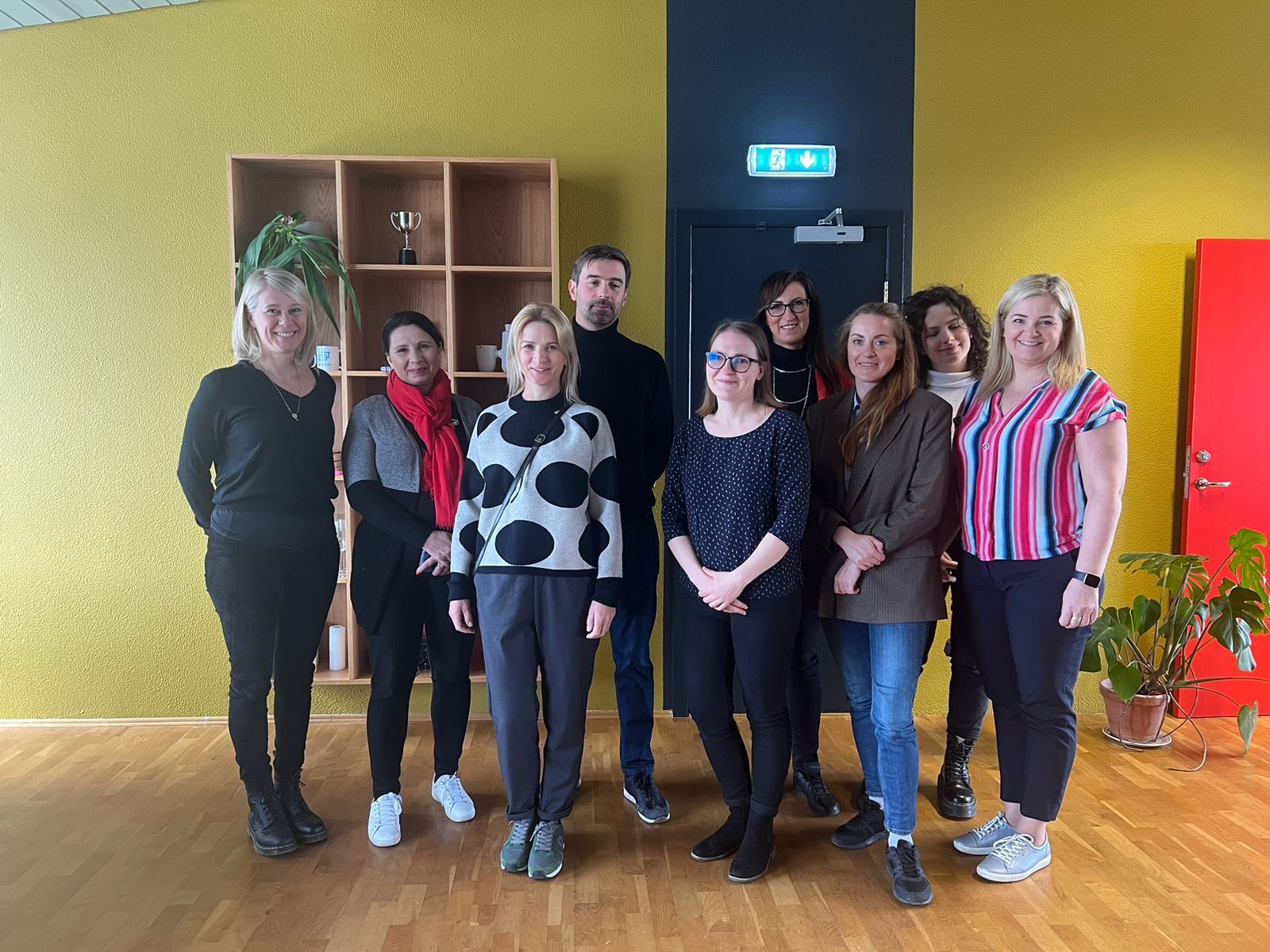
On 5th and 6th June, 2023, partners in the Foster project "How to Manage Life Wisely Using Digital Technologies" (Kara Connect, CTS Customized Training Solution and CASE Center for Social and Economic Research) met in Iceland for another study visit.
The meeting on the first day took place at the headquarters of the host institution – Kara Connect, in Raykjavik and was an opportunity to present the results of the activities undertaken so far in the project, and they are:
- Report prepared by Kara Connect entitled: "Out-of-school education of young people at risk of social exclusion in Iceland – an overview of educational offers and innovative tools", on the issue of teaching about new technologies and their use in everyday life and on the issue of teaching through modern, digital solutions.
- CASE analysis entitled: "How to deal with everyday life by using digital technologies wisely? Diagnosis of educational needs of children in Foster homes in the area of the use of new technologies". The analysis identifies key topics where educational action should be taken - Digital footprint and identity; Privacy and security; Relationships and communication; Hate speech, hate; Financial management. The aim of the analysis was to identify knowledge gaps in the above thematic areas among caregivers and children from Foster homes.
- Educational materials entitled: "How to cope in everyday life, using digital technologies wisely?". Educational materials were created for children and caregivers in Foster homes, on 5 topics selected on the basis of CASE`s analysis. Among the materials for children there are: videos, infographics, graphics, educational games and training packages. Materials for caregivers include: instructional videos, training scenarios, instructions for conducting trainings and a manual in electronic and paper versions. Educational materials are available on the FOSTER - CTS SZKOLENIA PL website. They can be used free of charge. They are open, available to everyone without logging in.
The next stage of the meeting was to discuss the upcoming activities in the project, the division of tasks between partners and formal issues related to the interim report.
The visit was also the time to summarize after the meeting of partners in Warsaw and to indicate the differences between the systems of care for children in Foster homes and foster families in Poland and Iceland. The partners exchanged knowledge, insights and proposals to help children in Foster homes, mainly with regard to the use of digital technologies.
During the second day, partners from Poland had the occasion to visit several institutions in Iceland that provide key support to children growing up without parents. Just like during the visit of a partner from Iceland to a Warsaw children's home in March, partners from Polish had in Reykjavik a great opportunity to compare the best practices of the Icelandic and Polish systems care.
The first of these was the Trappa center, which offers online treatment to children of all ages for speech or reading disorders or other problems requiring consultation with a specialist in various fields (delayed speech development in children and multilingual adolescents, diagnosis of speech development, diagnosis of speech defects, speech therapy, stuttering therapy, therapy for people with aphasia (after a stroke), consultations for parents and specialists. Thanks to Trappa employees, it is possible to access support and professional counseling for children throughout the country. According to Trapp's founder, Tinna Sigurðardóttir, online services with specialists are becoming increasingly popular in schools or educational institutions also outside the capital, where direct access to specialists is limited and help is very much needed.
The second place visited by the partners was Bernavern, the Reykjavik Child Protective Services (CPS), acting on behalf of the local government, which helps children and parents in serious difficulties in ensuring the future well-being and safety of children through a wide range of advice, support and professional solutions. The director of the Agency, Anita Ragnarsdóttir told us that in Iceland there are residential homes, family homes and foster homes that are designed for children who, for various reasons, are unable to stay at home with their biological parents, so they need a second, temporary home. In these homes, children live in safe conditions for a short time. Parents and children receive broadly understood support during the child's stay in a nursing home. Caregivers may be invited to spend time with the child. Efforts are also made to help the family communicate, parents receive training and support to meet their children's needs and become a better parent. However, if for some reason the child cannot return to his biological parents, he goes permanently to a foster family.
Another institution we visited was Barna - the National Agency for Children and Family, which is the central advisory center on children's issues in Reykjavik. We met there a director, Páll Ólafsson, who explained that the role of institution is to supervise the activities and work based on child protection, legislation, the establishment of subsidiary bodies, the provision of services for the welfare of children both in the capital and in the municipalities. The Agency offers a "toolbox" of support in all individual cases. It also points out digital solutions for children that will keep them safe online. The most important child protection authority in Iceland is the Ministry of Education and Children, National Agency for Children and Families “Barna” acts on behalf of the Ministry. It also cooperates with the Child Protection Committee, which is responsible for child protection at local level.
Thanks to these visit we reached private, local and government institutions with information about the project.
A visit to Iceland can be considered very successful. Partners are enriched with new facts, information and insights on the issues of childcare in foster system in Iceland, as well as their upbringing in a digitally safe world. Meetings with people in the most important institutions dealing with child protection are, without a doubt, an invaluable source of tips, advice and news. Partners from Poland have gained knowledge about the childcare system in Iceland. They learned that Iceland places great emphasis on the welfare of the child. The country has high standards of social services that support the well-being and development of children. The protection and safety of children are priorities and Iceland has robust childcare laws and support systems. The differences in social care systems in Iceland and Poland show what elements can be used from both systems to provide a better education for children. Good practices from both countries and the exchange knowledge about them serve educators and teachers. In addiotion, trainers will use the knowledge gained in the project to enrich their trainings during their worksops/lecture and activities outside the project. The information gained by the Polish partners will allow it to be used in the dissemination of project results and during dissemination events.
After the working meetings, the partners from Poland had the opportunity to see some amazing places in Iceland and enjoy the beauty of this region.
.jpg)